New Doors · Woodstock
Commercial Sectional Door Repair
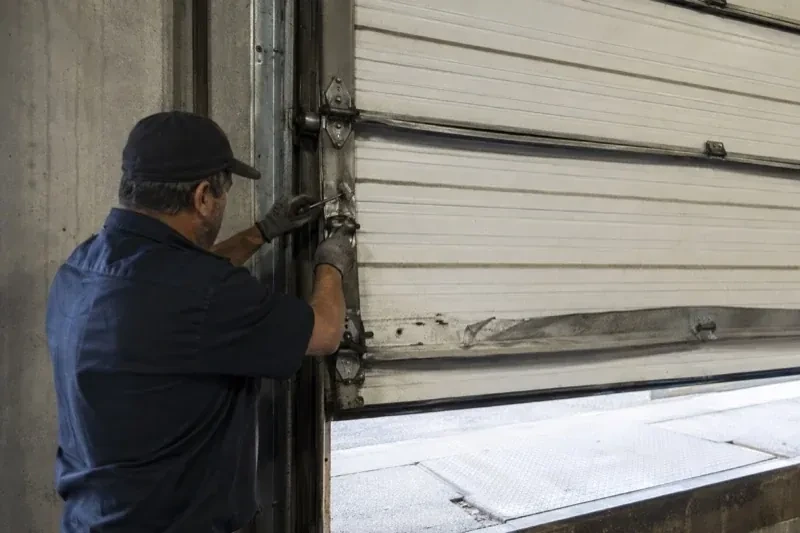
A forklift clipped the bottom panel while backing through the bay. The section is creased near an end stile, the lower roller rubs the track, and daylight now shows along one corner when the door closes.
Commercial Sectional Door Repair
In plain words
Unusual sound is useful diagnostic information on a commercial sectional door. A knock at the track curve suggests different issues from a steady bearing growl, a scraping section or operator-chain chatter. The technician listens during a controlled cycle, then inspects the hardware at the point where the sound appears. Worn rollers, loose hinges, dry bearings, displaced track and drive components can each be dealt with directly. The completed repair finishes with lubrication where specified and repeated observation of the previously noisy part of travel.
How the visit goesA high-lift door begins smoothly, then a cable loses tension as the top sections change direction. The loose cable no longer follows its drum grooves evenly, leaving the door unreliable at the top of travel.
Woodstock
How the visit goes
Starting with the impact point
After a vehicle or load contacts the door, the first inspection follows the force beyond the visible crease. The technician checks the panel skin, insulation, end stiles, reinforcement struts and hinge mounting areas, then looks at the nearest rollers and vertical track. Jamb brackets and anchors are examined for movement that could alter the entire travel path. Door position matters too: damage near the bottom fixture receives special handling because the lift cable connects there under tension. This mapped assessment distinguishes a replaceable section from a wider structural and hardware repair.
Restoring cables and counterbalance
Cable and spring work is performed with the door secured and spring energy under deliberate control. Matched lift cables are routed from sound bottom fixtures to compatible drums, seated in their grooves and brought to equal tension. Bearings, shaft alignment and anchor points are checked before springs are set for the actual door weight and lift configuration. The technician then evaluates balance at several positions. A level bottom edge and stable movement show that both sides are sharing the load as intended rather than relying on the operator to pull the door straight.
A repaired section that works with its neighbours
A replacement panel leaves the door with continuous joints, secure hinges and reinforcement suited to the opening. Colour and surface texture may show normal differences between new and weathered material, while the functional check focuses on articulation, roller clearance and even contact at the seals. Washing the exterior with products allowed by the door manufacturer helps protect the finish. Future impact marks near an end stile or bottom fixture deserve early attention because these areas connect the panel to the guidance and lifting systems.
Commercial Sectional Door Repair
In the van
- Bottom fixtures
- Reinforcement struts
- Bottom seal and retainer
- Track brackets and back hangs
- Torsion springs
What affects the quote
Same fees day, night or weekend
1Section construction and finish
Steel, aluminum, insulated sandwich and full-vision sections have different profiles, reinforcement, glazing and hardware patterns that affect matching and replacement scope.
2Corrosion and seized fasteners
Moisture and salt can affect cables, brackets, retainers, rollers and connections, broadening the repair when hardware cannot be removed or reused cleanly.
3Counterbalance components involved
Spring count, shaft arrangement, drum type, cable dimensions, bearings and bottom fixtures determine which tensioned parts must be controlled, replaced and reset together.
Commercial Sectional Door Repair: questions
How are replacement rollers chosen for a commercial door?
Roller diameter, stem length, bearing construction, track size and expected door use all shape the choice. The hinge position also matters because numbered end hinges place rollers at different offsets as the panels stack. The technician checks track condition and the mounting areas before fitting new rollers, so renewed hardware runs in a stable and correctly aligned guide.
What makes a sectional door different from a rolling door?
A sectional door is built from horizontal panels joined by hinges. Rollers guide those sections through vertical, curved and sometimes horizontal track. A rolling door uses narrow slats that coil around a barrel above the opening. Because the constructions differ, sectional repair centres on panels, hinges, rollers, tracks, lift cables and counterbalance components matched to that system.
How should a repaired door be lubricated?
Use the product and interval specified by the door manufacturer. Hinges, roller bearings, shaft bearings and springs may have defined lubrication points, while track generally benefits from being clean rather than coated with material that holds grit. High-use openings may need a different schedule. The service record can note what was applied and where for consistent future care.
Installation & Upgrades
- Insulated Steel Garage Door InstallationSeveral sections are dented and the bottom edge has begun to rust.
- Wind-Rated Garage Door ReplacementStrong gusts make the centre of your wide garage door bow inward and the rollers chatter in their…
- Carriage-House Garage Door InstallationThe existing door has reached the point where panels, rollers and finish all look tired.
Commercial Sectional Door Repair near you
A garage door in Woodstock rarely fails all at once. It gets louder, slower or less even first. Our services are arranged so you can act at any point: a tune-up while it is still working, a repair when something lets go, or a replacement when the door has earned its retirement.